





The dual nature of urolithin A: from natural metabolism to artificial creation
(I) Natural Urolithin A: A “Metabolic Gift” from Gut Microbiota
Natural urolithin A is not directly present in food, but is a secondary metabolite produced by the hydrolysis and metabolism of ellagitannins from plants such as pomegranates and walnuts by the human gut microbiota. Its synthesis efficiency is significantly affected by individual differences in gut microbiota; only about 40% of the population has the ability to efficiently convert it, and its bioavailability is constrained by multiple factors such as dietary structure and gut health. Naturally sourced urolithin A is often accompanied by complex polyphenolic compounds, forming a synergistic antioxidant effect, but it may also introduce impurities, requiring purification through techniques such as chromatography and membrane separation.
(II) Synthetic Urolithin A: Precise Construction through Chemistry and Biotechnology
Synthetic pathways mainly include chemical total synthesis and microbial engineering synthesis. Chemical synthesis constructs the benzopyranone core structure through condensation and oxidation reactions of phenolic intermediates, requiring solutions to regioselectivity and chiral control challenges; microbial synthesis utilizes gene editing technology to modify yeast or engineered bacteria to achieve the targeted conversion of ellagic acid to urolithin A, offering advantages of high purity (≥98%) and low solvent residue. The synthetic process can overcome the yield limitations of natural sources, and the single, controllable composition facilitates formulation development, but attention must be paid to catalyst residue and environmental compliance during the synthesis process.
 Functional Characteristics Comparison: Similarities and Differences in Bioactivity and Mechanisms of Action
 Functional Characteristics Comparison: Similarities and Differences in Bioactivity and Mechanisms of Action
(I) Basis of Consistency in Core Efficacy
In terms of core efficacy, synthetic Urolithin A and natural Urolithin A exhibit a high degree of consistency. Both can activate the mitochondrial autophagy pathway, playing a key role in cellular energy metabolism and health maintenance. Specifically, they can induce the mitochondrial protease PINK1/Parkin signaling pathway, prompting cells to clear senescent and damaged mitochondria, thereby improving the energy metabolism efficiency of muscle cells. Numerous clinical studies provide solid evidence for this efficacy. In a study of elderly individuals, after 4 months of Urolithin A intervention, participants’ muscle endurance significantly improved, increasing by 7-8 times. Both synthetic and natural Urolithin A showed similar positive effects in this process.
In terms of anti-inflammatory mechanisms, both also show consistency. They both inhibit the NF-κB pathway, a key signaling pathway in inflammatory responses. By inhibiting this pathway, Urolithin A can reduce the levels of pro-inflammatory factors such as TNF-α and IL-6, thereby alleviating inflammatory responses. This anti-inflammatory property makes Urolithin A potentially beneficial for inflammatory diseases such as enteritis and arthritis, providing new ideas and options for the prevention and adjuvant treatment of related diseases.
(II) Differentiated Performance and Limitations
Natural Urolithin A, due to its complex source and composition, may have some unique synergistic effects. Studies have found that the small amounts of isomers and polyphenol derivatives contained in natural Urolithin A can enhance the expression of intestinal tight junction proteins (such as Claudin-1 and ZO-1), thereby repairing and strengthening the intestinal mucosal barrier. In inflammatory bowel disease models, natural Urolithin A showed alleviation of intestinal inflammation and improvement of intestinal barrier function, which may be closely related to the synergistic effects of its complex components.
Synthetic Urolithin A, on the other hand, has significant advantages in purity and pharmacokinetic characteristics. Because it is synthesized through precise chemical synthesis or microbial engineering, its purity usually reaches ≥98%, making its pharmacokinetics easier to control. Its peak plasma concentration (Cmax) and time to reach peak concentration (Tmax) are relatively stable. This characteristic makes synthetic urolithin A highly suitable for standardized dosage design as a functional food ingredient, providing consumers with a more consistent and predictable efficacy experience. However, due to its relatively simple composition and lack of the synergistic effects that might be provided by the complex components found in natural urolithin A, it may exhibit certain limitations in physiological processes that require the synergistic action of multiple components.
 Key Decision Points for Brand Owners: A Holistic Approach from Raw Materials to Market
 Key Decision Points for Brand Owners: A Holistic Approach from Raw Materials to Market
(I) Safety and Quality Control
Whether it’s natural or synthetic urolithin A, safety and quality control are crucial aspects that brand owners need to focus on.
For naturally sourced urolithin A, the safety risks are primarily related to the cultivation and processing of the raw materials. Taking pomegranates as an example, pesticides may be used during pomegranate cultivation, leading to a risk of excessive pesticide residues in the final extracted urolithin A. Microbial contamination is also a significant concern; if hygiene conditions are not properly controlled during the collection, storage, and processing of raw materials, microbial contamination can easily occur. Furthermore, mycotoxins such as ochratoxin A may also be present in natural raw materials, posing a potential threat to human health. To ensure product quality, it is recommended to use high-performance liquid chromatography-mass spectrometry (HPLC-MS/MS) technology to detect ellagic acid derivatives and impurities, precisely controlling the purity and impurity content of the product.
For synthetic urolithin A, the focus should be on monitoring the residues of synthetic intermediates. During the chemical synthesis process, byproducts such as benzoquinones may be produced. If these substances remain in the final product, they may have adverse effects on the human body. In terms of quality standards, it is recommended to adhere to the relevant standards of the United States Pharmacopeia (USP)/National Formulary (NF), strictly testing for heavy metals, solvent residues, and other indicators. For example, solvents commonly used in the synthesis process, such as N,N-dimethylformamide (DMF) and ethanol, must have residue levels that meet standard requirements to ensure product safety.
For both natural and synthetic urolithin A, stability testing is an essential step. Urolithin A is sensitive to light, heat, and oxidation, so it needs to be stored under light-protected and low-temperature conditions (≤4℃) to prevent oxidative degradation and ensure product quality stability within its shelf life.
(II) Regulatory Compliance and Labeling Statements
In terms of regulatory compliance, different regions have varying regulations for natural and synthetic urolithin A.
The European Food Safety Authority (EFSA) classifies natural urolithin A as a “novel food ingredient” (NF17/2023). This means that if brands want to launch products containing natural urolithin A in the EU market, they need to submit relevant data on gut microbiota conversion efficiency to prove the product’s safety and efficacy. This regulation aims to ensure that consumers can safely consume this new food ingredient and also provides a unified standard for product quality in the market.
In the United States, the Food and Drug Administration (FDA) requires that synthetic urolithin A, when used as a dietary supplement ingredient, must have GRAS (Generally Recognized as Safe) certification. This certification is an acknowledgment of the safety of synthetic urolithin A, and only products with GRAS certification can legally enter the US dietary supplement market. When applying for certification, brands need to provide sufficient scientific data and research reports to prove that the product will not harm human health under normal use conditions.
Regarding labeling, brands must clearly distinguish whether the urolithin A in the product is from a “natural source” or “synthetically produced” to avoid misleading consumers. For example, for natural urolithin A products derived from pomegranate extract, the label can state “Derived from pomegranate extract, rich in natural urolithin A”; while for artificially synthesized urolithin A products, the label should state “Artificially synthesized bioactive ingredient urolithin A, precisely controlled dosage, providing you with efficient health care.” This labeling method allows consumers to clearly understand the source of the product’s ingredients and make more informed purchasing decisions.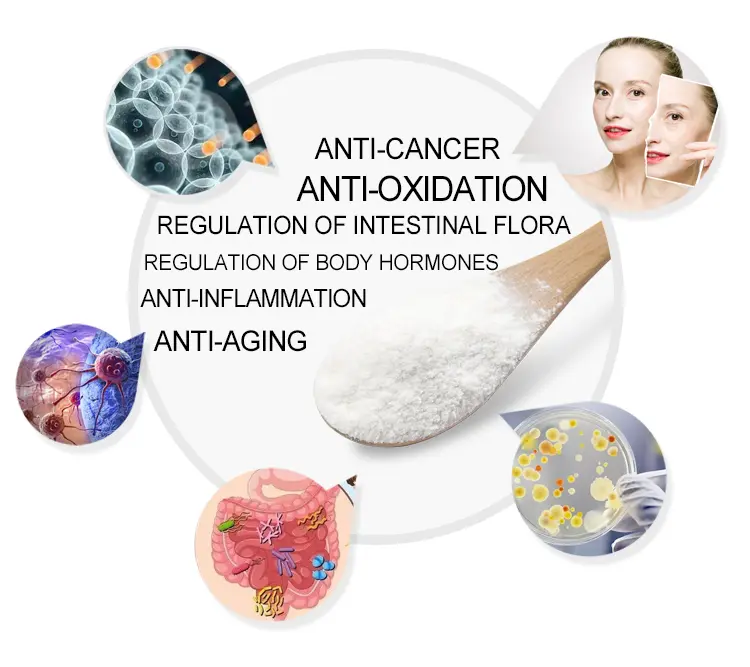
(III) Application Scenario Adaptability
Natural urolithin A and synthetic urolithin A each have their own advantages in application scenarios, and brands need to choose the appropriate raw materials based on product positioning and the needs of the target market.
Due to its natural origin, natural urolithin A is more suitable for products that emphasize the “natural health” concept. In the high-end dietary supplement field, daily doses of 1-2g of natural urolithin A products can meet consumers’ needs for natural and pure nutritional supplements. Combining natural urolithin A with other natural ingredients such as pomegranate polyphenols to develop functional beverages can not only enhance the product’s antioxidant effects but also leverage the natural flavor of pomegranate to improve the taste and appeal of the product. In the cosmetics field, the transdermal absorption properties of natural urolithin A allow it to effectively improve skin mitochondrial function, reduce wrinkles and sagging, providing a natural and safe active ingredient option for anti-aging cosmetics.
Synthetic urolithin A, on the other hand, demonstrates significant advantages in areas requiring precise dosage control. In sports nutrition products, synthetic urolithin A can precisely enhance muscle repair capabilities, helping athletes and fitness enthusiasts recover faster and improve athletic performance. Due to its high purity and stability, synthetic urolithin A is particularly suitable for solid dosage forms requiring high ingredient stability, such as tablets and capsules, making it convenient for consumers to carry and use. In the field of pharmaceutical intermediates, the controllability and consistency of synthetic urolithin A make it an ideal raw material for developing innovative drugs such as those for the auxiliary treatment of Alzheimer’s disease, providing a stable and reliable foundation for pharmaceutical research and development.
(IV) Cost-Effectiveness and Supply Chain Risks
Cost-effectiveness and supply chain risks are important factors that brand owners need to consider comprehensively when choosing urolithin A raw materials.
The supply of natural urolithin A is significantly affected by fluctuations in agricultural product harvests. Climate disasters in major pomegranate-producing regions such as Iran and Turkey, such as droughts and floods, can lead to a decrease in pomegranate yield, resulting in price fluctuations of ±30% for natural urolithin A. This price instability poses a significant challenge to brand owners’ cost control and may affect product market pricing and profit margins.
Although the initial equipment investment for the production of synthetic urolithin A is higher, requiring the purchase of specialized equipment such as fermentation tanks and chromatography columns, with the advancement of large-scale production, its cost can be reduced to 60% – 70% of that of natural raw materials. Large-scale production can reduce the production cost per unit product and improve production efficiency, making synthetic urolithin A more competitive in price. When evaluating cost-effectiveness, brand owners also need to consider the target market’s acceptance of the premium associated with the “natural” concept. In the European market, consumers prefer naturally sourced products and are willing to pay a 20% – 30% premium; while in the Asian market, consumers are more concerned about product cost-effectiveness and evidence-based functional claims, and are more price-sensitive. Brand owners need to weigh the costs and benefits of natural and synthetic urolithin A based on the characteristics of different markets to choose the most suitable raw material.
Future Trends: From Single Raw Materials to System Solutions
 Future Trends: From Single Raw Materials to System Solutions
(I) Technological Innovation Drives Product Upgrades
In the research and application of urolithin A, technological innovation is becoming the core driving force behind product upgrades.
In the field of microbial synthesis technology, there is an active shift towards “green chemistry.” Traditional synthesis methods often rely on large amounts of organic solvents, which not only put significant pressure on the environment but also increase production costs. Now, researchers are committed to using aqueous catalytic systems to replace organic solvents. This new catalytic system uses water as the reaction medium, which is not only environmentally friendly but also reduces production costs. By optimizing microbial fermentation conditions, including temperature, pH value, and nutrient supply, the yield and purity of urolithin A can be significantly improved. Some research teams have used gene editing technology to precisely regulate the metabolic pathways of microorganisms, enabling them to synthesize urolithin A more efficiently, making large-scale industrial production possible.
In the field of natural raw materials, researchers are exploring a “precursor-microbiome” synergistic approach. The core of this approach is to develop functional foods rich in ellagitannins and combine them with specific probiotics to improve the efficiency of the body’s own synthesis of urolithin A. For example, researchers have found that combining pomegranate extract with specific probiotics can significantly improve the metabolic capacity of gut microbiota for ellagitannins, thereby increasing the synthesis of urolithin A. This method not only reduces the body’s dependence on exogenous urolithin A supplementation but also improves overall health by regulating the balance of gut microbiota. In the future, with the continuous deepening of research on gut microbiota, this “precursor-microbiome” synergistic approach is expected to become an important development direction for the production of natural urolithin A.
(II) Expanding Application Scenarios in the Era of Precision Nutrition
With the advent of the era of precision nutrition, the application scenarios of urolithin A are constantly expanding.
In response to the needs of an aging society, significant progress has been made in the research of urolithin A in combination with other nutrients. The “muscle health package” combining urolithin A with whey protein aims to provide more comprehensive muscle health support for the elderly. Whey protein is rich in various essential amino acids and is an important raw material for muscle repair and growth, while urolithin A can activate mitochondrial autophagy and improve the energy metabolism efficiency of muscle cells. The combination of the two can more effectively prevent and improve muscle atrophy in the elderly. The “mitochondrial optimization formula” combining urolithin A and Omega-3 has also entered the clinical stage. Omega-3 fatty acids have various health benefits, including anti-inflammatory and lipid-regulating effects. In combination with urolithin A, they can further optimize mitochondrial function, enhance cellular antioxidant capacity, and have potential benefits for cardiovascular health and cognitive function.
In the field of cosmetics, urolithin A has also shown great potential. Transdermal drug delivery systems containing urolithin A have become a research hotspot. Through liposome encapsulation technology, urolithin A can more effectively penetrate the skin barrier and increase its penetration rate in the dermis. Liposomes are tiny vesicles composed of phospholipids and other substances, whose structure is similar to cell membranes. They can encapsulate urolithin A, protecting it from degradation and promoting its entry into skin cells. This transdermal drug delivery system allows urolithin A to directly act on the mitochondria of skin cells, reducing wrinkles and sagging, becoming a new selling point for anti-aging skincare products. In the future, with the continuous innovation of transdermal drug delivery technology, the application prospects of urolithin A in the cosmetics field will be even broader.
(III) Sustainable Development and Brand Value Alignment
In the context of today’s consumers’ high concern for sustainable development, urolithin A manufacturers are actively linking sustainable development concepts with brand value.
Companies using synthetic routes are improving their ESG (Environmental, Social, and Governance) scores by obtaining carbon footprint certifications. During the fermentation process, they use renewable energy sources such as solar and wind power to replace traditional fossil fuels, thereby reducing carbon emissions. Some companies also optimize production processes to improve energy efficiency and further reduce their environmental impact. This sustainable production method not only helps address global climate change but also enhances the brand’s image in the minds of consumers, attracting more environmentally conscious consumers.
Natural ingredient brands are strengthening their differentiated brand identity by building a traceability system “from orchard to product.” Taking pomegranates as an example, brands can meticulously record information such as the planting location, cultivation methods, and harvesting time of the pomegranates, and transparently display this information to consumers through technologies like blockchain. Brands can also emphasize concepts such as organic farming and fair trade. Organic farming avoids the use of chemical pesticides and fertilizers, ensuring the natural purity of the raw materials; fair trade ensures that farmers receive reasonable income, promoting social fairness and harmony. This traceability system and the creation of differentiated labels can meet the Z generation consumers’ demand for transparent supply chains, enhancing consumer trust and loyalty to the brand.
Synthetic and natural urolithin A are not in competition, but rather form a complementary ecosystem. Brands need to select raw material solutions that balance technological maturity and cost based on target market positioning, product dosage form, efficacy focus, and regulatory environment, while also paying attention to cutting-edge research (such as optimizing the blood-brain barrier penetration of urolithin A derivatives) to seize market opportunities in the anti-aging and metabolic health fields.
