







Anthocyanins are the primary functional phytochemicals that establish blackcurrant as a premium clean-label berry ingredient across the food and beverage sector. These water-soluble plant pigments deliver the fruit’s characteristic deep violet-red color and notable antioxidant properties, making blackcurrant anthocyanins widely applied in functional drinks, nutritional supplements, gummy confectionery and natural colorant systems.
Blackcurrant anthocyanins possess a distinct compound composition. Under standardized in vitro test conditions, they demonstrate strong free-radical scavenging capacity and favorable formulation compatibility compared with anthocyanins sourced from other common berries. This comprehensive guide targets food formulators and bulk raw material buyers, covering the chemical profile, potential functional properties, processing impacts, stability performance and commercial use cases of blackcurrant anthocyanins.
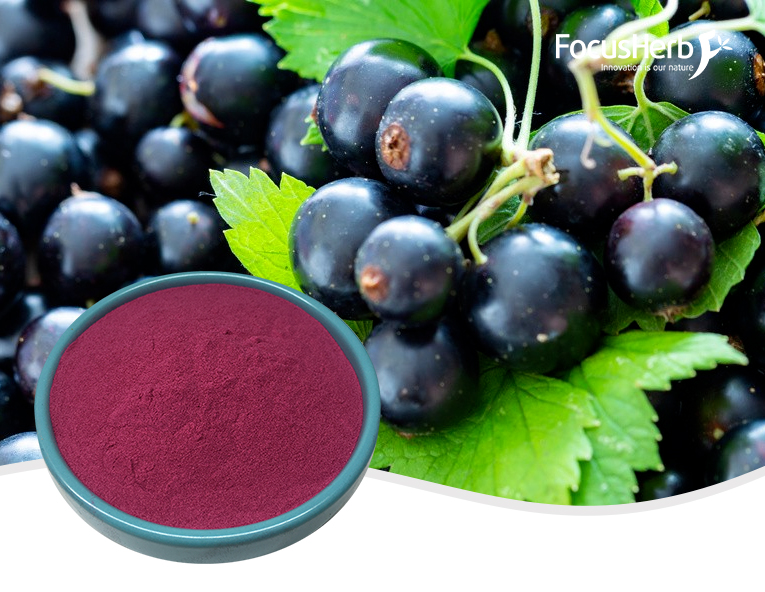
What Are Blackcurrant Anthocyanins?
Blackcurrant anthocyanins belong to a class of natural phenolic flavonoids, endogenously synthesized in the peel and pulp of Ribes nigrum L. fruits. In nature, these pigments protect fresh berries against UV radiation, microbial invasion and oxidative damage during growth. When incorporated into food formulations, they retain inherent antioxidant characteristics.
Different from ingredients containing single-type anthocyanins, blackcurrant features a complex blend of multiple anthocyanin subtypes, forming a synergistic antioxidant system. Blackcurrant anthocyanins are typically dominated by delphinidin- and cyanidin-based glycosides, with relative proportions varying significantly depending on berry cultivar, growing region (Northern Europe, UK, China), ripeness, and post-harvest processing conditions. The four primary anthocyanin glycosides present in fresh and processed blackcurrant fruit include Delphinidin-3-rutinoside, Cyanidin-3-rutinoside, Delphinidin-3-glucoside, and Cyanidin-3-glucoside.
Commercially available freeze-dried blackcurrant powder effectively preserves these natural active pigments, which serve as the core selling point for blackcurrant-based functional food products.
Full COA Standard Technical Specifications (HPLC Tested)
Below are standardized B2B-grade specifications for bulk organic blackcurrant powder, fully aligned with international food ingredient audit and COA documentation requirements:
| Parameter | Specification |
|---|---|
| Total Anthocyanins (HPLC) | 10% / 15% / 25% / 35% customizable |
| Main Active Components | Delphinidin & Cyanidin glycosides (majority fraction) |
| Color Value (E1%1cm, 520nm) | ≥ 450 (varies by anthocyanin grade) |
| Moisture Content | ≤ 5.0% |
| Water Solubility | 100% fully water-soluble, no residue |
| Particle Size | 80–200 mesh (customizable) |
| Raw Material pH (1% Aqueous Solution) | 3.0 – 4.0 (natural acidic) |
| Bulk Density | 0.4–0.6 g/cm³ |
| Heavy Metals | Pb ≤ 2ppm; As ≤ 1ppm; Cd ≤ 0.5ppm; Hg ≤ 0.1ppm |
| Microbial Limits | Total Plate Count ≤ 1000cfu/g; Yeast & Mold ≤ 100cfu/g; E. coli Negative |
| Residual Solvents | Not detected (zero solvent addition) |
| Shelf Life & Storage Stability | 24 months sealed (cool, dry, dark conditions); 12 months stability guaranteed after opening |
Why Blackcurrant Anthocyanins Stand Out Among Berry-Derived Variants
While most berries contain anthocyanins, blackcurrant-derived anthocyanins gain recognition in premium food formulation for three key characteristics:
1. Diversified Compound Profile
Blackcurrant does not rely on a single anthocyanin constituent. Its rich glycoside composition delivers a broad-spectrum antioxidant effect and good biological compatibility. Relevant in vitro assays indicate this complex profile may support the regulation of oxidative stress in the human body, distinguishing it from generic berry powders with simple single-pigment structures.
2. Good Aqueous Dispersibility
As water-soluble pigments, blackcurrant anthocyanins can be easily incorporated into liquid formulas such as beverages and liquid supplements. It should be noted that the oral bioavailability of anthocyanins is generally low (less than 1%). Nevertheless, research shows their circulating metabolites may exert biological activities, with absorption pathways differing from those of fat-soluble plant antioxidants.
3. Dual Function: Nutrition & Natural Coloring
Blackcurrant anthocyanins act simultaneously as functional nutritional ingredients and clean-label natural colorants. Manufacturers can reduce the usage of synthetic additives, simplify ingredient lists and enhance the clean-label attributes of finished products.

Potential Functional Research Directions
Existing in vitro, animal, and preliminary human studies have investigated blackcurrant anthocyanins for multiple physiological associations. All functional descriptions below are framed as ongoing research topics, not confirmed health benefits, complying with global food labeling and advertising regulations.
Natural Antioxidant Capacity
Blackcurrant anthocyanins are studied for their potential association with neutralizing reactive oxygen species (ROS) and mitigating cellular oxidative stress in in vitro models. As a natural antioxidant ingredient, it aligns with mainstream superfood and clean-label formulation trends focused on daily wellness ingredient profiling.
Visual Fatigue Research Correlation
Preliminary studies suggest potential benefits related to visual fatigue regulation linked with blue light exposure, although comprehensive clinical evidence remains limited. Blackcurrant anthocyanins are continuously investigated in relation to retinal microcirculation status in human observational trials.
Exercise Oxidative Stress Modulation
Clinical observations and preliminary trials indicate blackcurrant anthocyanin supplementation is researched for potential association with relieving exercise-induced oxidative stress, though standardized large-scale human validation is still ongoing.
Daily Physiological Maintenance Research
Long-term anthocyanin intake is investigated in relation to age-related physiological function changes, with preclinical data indicating potential supportive effects on bodily homeostasis.
How Processing Affects Anthocyanin Retention
Anthocyanins are heat-sensitive active substances. Drying technology directly impacts the final anthocyanin content and activity, which further determines product grade and application scenarios.
Freeze-Drying
Low-temperature vacuum freeze-drying avoids thermal degradation. Under optimized low-temperature vacuum processing conditions, this technology can retain up to 85–95% of natural anthocyanins, polyphenols and vitamins in whole blackcurrants. Freeze-dried powder maintains complete functional activity and stable color performance, ideal for high-end functional formulas with strict requirements on nutritional efficacy.
Spray-Drying
High-temperature spray-drying will partially damage the molecular structure of heat-sensitive anthocyanins. Combined with conventional dextrin dilution, spray-dried blackcurrant powder presents lower anthocyanin concentration and activity, with a typical retention rate roughly between 60% and 75%. It is mainly applied to common flavoring formulas without strict functional demands.
For more technical comparisons, refer to our article: Freeze-Dried vs Spray-Dried Blackcurrant Powder: Key Differences & Best Uses.
Color & Stability Guide for Food Formulators
The color expression and stability of blackcurrant anthocyanins vary significantly under different pH, temperature and light conditions. The detailed stability profile is summarized below:
| Influence Factor | Stability Performance | Formulation Remarks |
|---|---|---|
| pH 2.0 – 4.0 | Excellent | Presents bright violet-red, the most applicable range for fruit teas and functional drinks |
| pH 4.5 – 5.5 | Moderate | Slight hue shift occurs, acceptable for general berry formulations |
| pH 6.0 – 7.0 (Neutral) | Poor | Prone to gradual fading and browning, not recommended for long-term shelf-stable neutral formulas |
| pH > 7.0 | Very poor | Obvious blue discoloration and rapid pigment degradation |
| Temperature ≤ 60°C | Good | Over 90% anthocyanin retention after 30 minutes constant temperature treatment |
| Temperature 80°C | Moderate | Approximately 75% anthocyanin retention |
| Temperature 100°C | Poor | Only 50% – 60% anthocyanin retention after high-temperature sterilization |
| Strong Light | Poor | Accelerates pigment fading and molecular degradation |
| Oxygen Exposure | Moderate | Induces slow oxidation and gradual color shift over shelf life |
Production & Storage Recommendations:
For commercial production, adopt low-temperature processing. Use opaque packaging and vacuum/nitrogen filling to preserve anthocyanin activity and color stability throughout the shelf life. Neutral formula bases are not recommended for products requiring long-term color consistency.
Top Commercial Applications of Blackcurrant Anthocyanins
1. Antioxidant Functional Beverages
Anthocyanin-rich blackcurrant powder is widely used in ready-to-drink antioxidant drinks, berry-flavored functional water and daily health beverages to highlight natural plant antioxidant ingredient attributes and clean-label formulation advantages.
2. Eye-Care Functional Foods
Commonly added into eye-care gummies, chewable tablets and protective beverages targeting students and office staff exposed to long hours of screen time, formulated based on ongoing visual fatigue-related ingredient research.
3. Sports & Fitness Nutrition
Applied in sports drinks, recovery powder blends and fitness supplements as a natural antioxidant ingredient for post-exercise formula optimization.
4. Clean-Label Natural Colorants
Replace synthetic red and purple pigments in snacks, candies and dairy products to achieve pure plant-based coloring and comply with global clean-label standards.
Frequently Asked Questions
What are the main applications of blackcurrant anthocyanins?
Blackcurrant anthocyanins serve as natural antioxidant ingredients and clean-label plant-based colorants for food and beverage formulation. They are widely researched for potential physiological correlations with visual comfort and post-exercise oxidative status regulation.
Does blackcurrant contain high levels of anthocyanins?
Yes. Blackcurrant is recognized as a temperate berry with high natural anthocyanin density. Optimally processed freeze-dried whole-fruit powder retains the maximum level of these active pigment compounds.
Will blackcurrant anthocyanins fade in beverage products?
Anthocyanins are inherently sensitive to light, heat and neutral/alkaline pH environments. Color fading and degradation may occur under extreme processing and storage conditions. Low-temperature production and opaque, vacuum-sealed packaging can effectively maintain color stability during the product shelf life.
Which type of blackcurrant powder retains more anthocyanins: freeze-dried or spray-dried?
Optimally processed freeze-dried blackcurrant powder maintains significantly higher anthocyanin content and structural activity than spray-dried variants, making it the preferred choice for high-end functional and clean-label products.
Can blackcurrant anthocyanins replace artificial food colorants?
Yes. The natural violet-red tone of blackcurrant anthocyanins serves as a compliant clean-label alternative to synthetic purple and red colorants for food and beverage production.
Final Thoughts
Blackcurrant anthocyanins are the core functional component that differentiates high-quality organic freeze-dried blackcurrant powder from ordinary fruit powder ingredients. Featuring a unique variable glycoside composition, measurable in vitro antioxidant capacity and dual functionality of nutrition and natural coloring, this raw material enables food brands to develop competitive clean-label, functional and visually appealing products.
A clear understanding of anthocyanin chemical characteristics, stability rules and processing impacts helps formulators select qualified raw materials and optimize product formulation and positioning.
If you are looking for bulk organic blackcurrant powder with standardized high anthocyanin content, please contact our team. We provide free product samples, full COA & HPLC specification reports and customized wholesale solutions for your formulations.
