







If you are developing a finished product with thymoquinone (TQ), you have probably already hit the same wall that almost every formulation team does: the molecule looks promising on paper, but translating it into a stable, absorbable, cost-effective ingredient is surprisingly hard.
This guide is written for R&D scientists, formulation chemists, brand product developers, and sourcing teams—not for consumers looking for a daily dose. We will break down why thymoquinone bioavailability is so limited, what published research shows, the six formulation strategies most often used to improve it, and how to choose between crude black seed oil and a standardized thymoquinone extract when you source.consumers can read [what the research says about Thymoquinone benefits]
This article is for industry professionals. It summarizes preclinical research and is not medical advice. Finished products must comply with the regulatory framework of your target market (DSHEA/FDA in the US, EFSA in the EU, NMPA in China, etc.).
What Is Thymoquinone—and Why Does Bioavailability Matter?
Thymoquinone (2-isopropyl-5-methyl-1,4-benzoquinone, C₁₀H₁₂O₂, MW 164.21 g/mol) is the main bioactive constituent of Nigella sativa (black seed) oil. It has been studied for antioxidant, anti-inflammatory, and antimicrobial activity across a large body of in vitro and animal research, which is why supplement, cosmetic, and functional food brands keep coming back to it.
But bioactivity in a petri dish does not automatically translate into a finished product. Bioavailability answers one question that decides whether your formula works: how much of the TQ you put on the label actually reaches systemic circulation (or its target tissue) in an active form?
For thymoquinone, the answer is “much less than you would hope”—and that problem starts before the molecule ever reaches the gut.
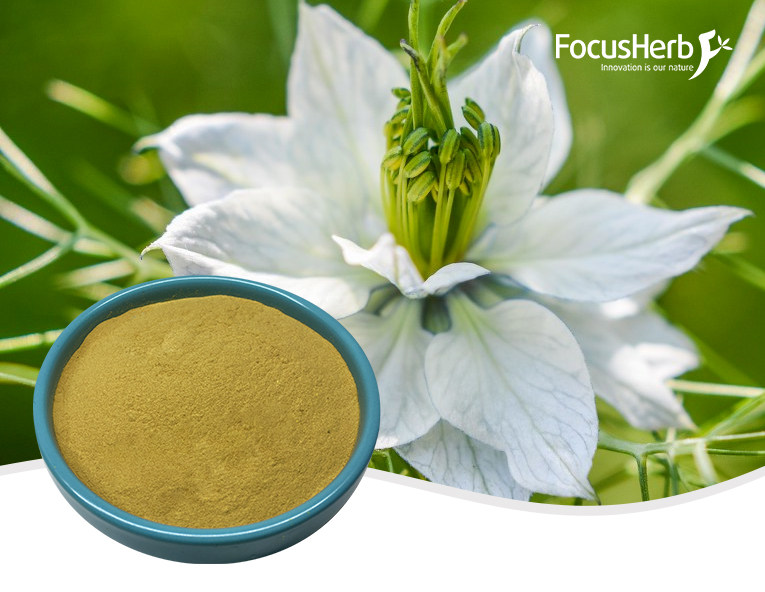
Why Is Thymoquinone’s Bioavailability So Low?
Three independent bottlenecks stack on top of each other.
1. Poor aqueous solubility (BCS Class II)
Thymoquinone is a lipophilic, essentially water-insoluble molecule. It is generally classified as a Biopharmaceutics Classification System (BCS) Class II compound: high membrane permeability but low aqueous solubility. Low solubility in gastrointestinal fluids directly limits the amount that can dissolve and be absorbed.
In practice, this means a plain TQ powder capsule swallowed with water delivers a small and highly variable fraction of the labeled dose.
2. Chemical instability to light, heat, and oxidation
TQ is a quinone. Quinones are prone to:
- Photodegradation under UV and visible light
- Thermal degradation during processing, drying, and storage
- Oxidation and reduction to hydroquinone or polymerization products
- Reaction with nucleophiles present in excipients (e.g., amine-containing fillers)
This is why raw black seed oil darkens over time, and why a poorly handled TQ extract can lose a large share of its labeled assay within a few months on the shelf. Stability is part of bioavailability: if it degrades before ingestion, it never had a chance to be absorbed.
3. Rapid first-pass metabolism and short half-life
In vivo studies in animal models report that TQ is rapidly absorbed but also rapidly metabolized and cleared, with a short plasma half-life. Significant hepatic first-pass extraction and glucuronidation/sulfation further reduce the free circulating concentration.
The combined effect of these three factors is that even a “pure” TQ ingredient often yields a much lower systemic exposure than the label percentage suggests.
How Low Is It? What the Literature Shows
We will not quote precise human pharmacokinetic numbers here, because published data comes mostly from animal models and a small number of human pilot studies, and the values vary widely with the formulation used. What is consistent across the literature is:
- Plasma peak concentrations are highly formulation-dependent—often 2- to 5-fold (and in some nanoformulations, an order of magnitude) higher when TQ is delivered in a solubilized carrier versus as a plain oil or powder.
- Raw black seed oil contains only ~0.5–1.5% TQ by weight, depending on seed origin, harvest, and extraction method. To deliver a meaningful TQ dose, you would need very large oil volumes—which is why brands increasingly move to standardized thymoquinone extracts (e.g., 10%–98% TQ by HPLC).
- Free TQ is light- and heat-sensitive; unprotected packaging and warehousing are routinely the hidden cause of “the supplement didn’t work” complaints.
If you need exact PK figures for a regulatory dossier, ask your supplier for literature references and stability data rather than relying on blog summaries.
Six Proven Strategies to Improve Thymoquinone Bioavailability
The formulation toolkit below is what you will see in the thymoquinone R&D literature. Pick based on your dosage form, cost target, and shelf-life requirements.
1. Self-Nanoemulsifying / Microemulsifying Drug Delivery Systems (SNEDDS / SMEDDS)
An oily TQ fill inside a hard or soft capsule, combined with surfactants and co-surfactants, spontaneously forms a nano- or micro-emulsion in gastric fluid. This keeps TQ solubilized, avoids the dissolution step, and is one of the most well-documented approaches for increasing TQ exposure.
Best for: softgels, liquid-filled hard capsules.
2. Liposomal and phospholipid-complexed TQ
Phospholipid-based carriers (liposomes, phytosomes, TQ–phospholipid complexes) wrap TQ in a lipid bilayer. This improves both solubility and mucosal uptake, and is a format consumers already recognize (“liposomal”).
Best for: premium supplements, functional beverages where taste and clarity matter.
3. Cyclodextrin inclusion complexes
Encapsulating TQ inside β-cyclodextrin or hydroxypropyl-β-cyclodextrin improves water dispersibility and photostability. It is a mature, GRAS-friendly technology widely used in the food and pharma industries.
Best for: tablets, powders, stick packs, water-based products.
4. Solid dispersions and amorphous forms
Dispersing TQ in a hydrophilic polymer (e.g., PVP, HPMC, maltodextrin) converts it into an amorphous state with much faster dissolution. This is a cost-effective route for dry dosage forms.
Best for: two-piece capsules, tablets, powders.
5. Polymeric and lipid nanoparticles
Nanoencapsulation (PLGA nanoparticles, solid lipid nanoparticles, nanostructured lipid carriers) shows some of the largest bioavailability gains in preclinical studies, but manufacturing cost and scalability can be higher.
Best for: clinical-grade or premium positioning; validate scale-up with your CDMO.
6. Use a stabilized, standardized extract instead of crude black seed oil
This is the often-overlooked “non-technological” lever. A quality-controlled standardized TQ extract—with a declared HPLC assay, protective packaging (amber glass, nitrogen flush, cold chain where required), and documented shelf-life—solves the stability half of the bioavailability problem before formulation even begins.
Crude black seed oil, by contrast, has variable TQ content, is prone to oxidation, and makes label claims hard to justify batch-to-batch.
Black Seed Oil vs. Standardized Thymoquinone Extract: A Sourcing Comparison
| Parameter | Crude Black Seed Oil | Standardized TQ Extract |
|---|---|---|
| TQ content | ~0.5–1.5%, highly variable | Declared % by HPLC (e.g. 10%, 50%, 98%) |
| Batch consistency | Low | High, with COA per batch |
| Dose per serving needed | Large (oil volume) | Small (mg-level) |
| Stability | Prone to oxidation and TQ loss | Better with controlled processing + packaging |
| Label claim support | Weak | Strong, traceable to assay |
| Typical use case | Softgels, traditional-formula products | Modern supplements, functional foods, cosmetics |
| Regulatory documentation | Limited | COA, MSDS/SDS, spec sheet, (often) residue & heavy-metal reports |
What B2B Buyers Should Ask Their Thymoquinone Supplier
Before you request a quote, make sure the supplier can answer these questions. The answers tell you almost everything about how serious they are:
- Assay method and value: “What is the TQ content, and is it measured by HPLC with a validated method? Please share a recent COA.”
- Source botanical: Nigella sativa seed? Country of origin? Organic / non-GMO available?
- Form: free-flowing powder, oil-soluble liquid, or pre-formulated (e.g., phospholipid complex, cyclodextrin)?
- Stability: shelf-life under recommended storage? Light/moisture protection? Is a stability study on file?
- Impurities: heavy metals (Pb, As, Cd, Hg), residual solvents, pesticides, microbial limits.
- Packaging: fiber drum, amber glass, nitrogen flush? Cold-chain required?
- Regulatory docs: COA, SDS, TSE/BSE-free statement, allergen statement, GMP certificate, ISO 9001, kosher/halal on request.
- Commercials: MOQ, lead time, sample policy (e.g., free 10–20 g sample), Incoterms, payment terms.
If a supplier hesitates on COA or HPLC methodology, walk away—this is the single most common failure point in TQ sourcing.
FAQ: Thymoquinone Bioavailability
Is thymoquinone BCS Class II?
Yes. TQ is generally treated as a BCS Class II compound: good permeability but poor aqueous solubility, which is why solubilization technologies (emulsions, liposomes, solid dispersions) are the standard approach to improving its bioavailability.
Does black seed oil contain thymoquinone?
Yes, but at only roughly 0.5–1.5% by weight, depending on seed source and extraction. That is the main reason brands move to a standardized thymoquinone extract when they need a consistent, labelable dose.
What destroys thymoquinone?
Light (especially UV), heat, oxygen, and alkaline conditions. It should be stored in amber, airtight containers, cool and dry, and protected from moisture.
What is the best way to take thymoquinone for absorption?
From a formulation standpoint, solubilized systems—SNEDDS/SMEDDS in softgels, liposomal products, or cyclodextrin-encapsulated powders—consistently outperform plain TQ oil or unformulated powder. The best choice depends on your dosage form and target market.
Can I buy pure 98% thymoquinone for my product?
Yes, high-purity TQ (typically ≥98% by HPLC) is available as a reference-standard-grade material for R&D and analytical use. For finished consumer products, most formulators choose a lower-but-consistent standardized extract (10%–50%) for cost, stability, and dosing practicality.
Bottom Line
Thymoquinone’s promise is real, but its bioavailability problem is real too. Poor water solubility, light/heat/oxidative instability, and rapid first-pass clearance stack together, which is why the “same mg of TQ” can perform very differently from one finished product to another.
As a formulator or brand buyer, your levers are:
- choose a standardized, assay-backed TQ ingredient rather than crude oil;
- pair it with a proven delivery system (emulsion, liposome, cyclodextrin, or solid dispersion) that matches your dosage form;
- lock down stability and COA documentation before you commit to volume.
Source Standardized Thymoquinone Extract with Full Documentation
We are a China-based botanical plant extract manufacturer specializing in thymoquinone from Nigella sativa. We supply:
- TQ 10%, 20%, 50% and 98% by HPLC, with batch-specific COA
- Free-flowing powder and oil-soluble liquid forms
- Full SDS, heavy-metal & microbial reports, GMP / ISO 9001 documentation
- Small R&D samples available for lab evaluation
Contact our team via the inquiry form on this site and tell us your target assay, dosage form, and monthly volume—we will send over the specification sheet, COA, and FOB/CIF quotation within one business day.
